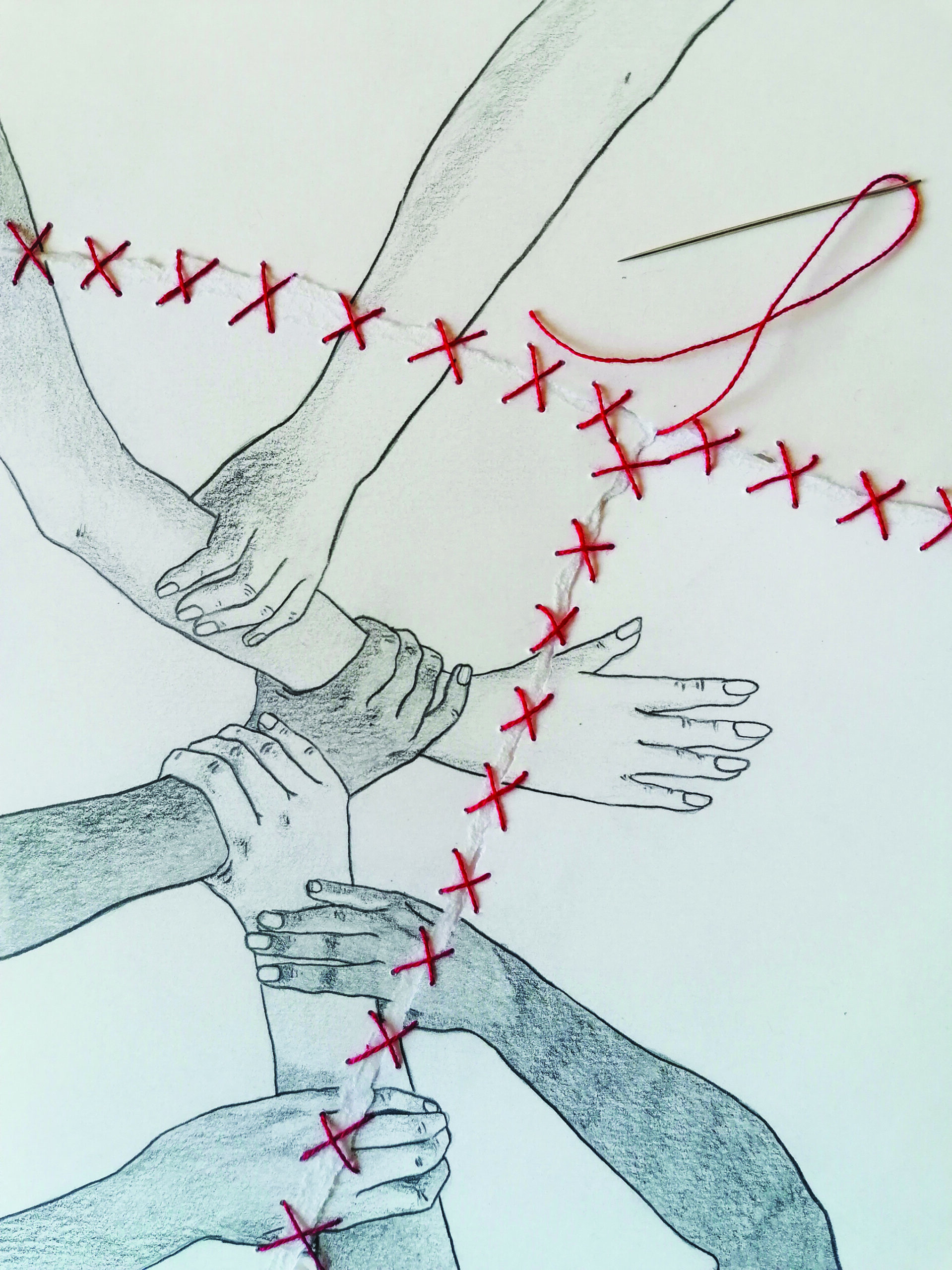


Campaign launch for the Undocumented Candidate. Photo: Rita María Habib
By Rafaela Pimentel (Territorio Doméstico) and Marta Malo (La Laboratoria)
Translation into English by Jennie Gant
The Undocumented Candidate was presented in Belgium in 2024, the product of an alliance between women with and without residency rights. Behind the collaged face of this fictional candidate for local elections are a group of around twenty women who set about exploring artistic ways of reclaiming the public space against the criminalization of migration and in favour of the free movement of people.
We first learned about her in 2024, when a small Belgian delegation visited the Territorio Doméstico’s School of Political Education, run by the domestic workers’ collective. Later that year, a large group of Territorio Doméstico members returned the visit to share the artistic tools they used in their struggle, including feminist cabaret and the theatre of the oppressed, with undocumented women’s collectives in Brussels.
Since then, a transnational bond of shared beliefs has brought the two collectives together. For both groups, our shared commitment to activism mixes with the conviction that the emotional dimensions that art can mobilize are fundamental to the struggle for a life worthy of the joy of living. After two years of meetings and conversations, we had the opportunity to conduct an in-depth interview and we jumped at the chance to bring the story of the Undocumented Candidate, along with the practices and horizons that underpin it, to the Spanish-speaking world.
On a hot summer’s afternoon, switching languages and swapping devices, we talked with Henriette Essami-Khaullot, Anna Rispoli, and Nina Ferrante, three of the people who founded the Undocumented Candidate. Henriette is a writer, trainer, and playwright, as well as a spokesperson for La Coordination des Sans-Papiers de Belgique. She has worked for years to create self-managed spaces for shelter and daily life, from which she produces analyses and research on the everyday realities of undocumented people like herself. Anna Rispoli and Nina Ferrante, for their part, are two Italian artist-researchers based in Brussels. Both explore the boundary between artistic creation and political action, driven by a deep commitment to migration justice and the redistribution of resources. The conversation would not have been possible without patient translation from our friend and ally Anouk Devillé.
Rafaela Pimentel & Marta Malo. We’d like to begin this interview with a very simple question: who is the Undocumented Candidate? What led to her being created?
Anna Rispoli. The Undocumented Candidate is a fictional character, but also a real one, because she is a composite of several real people; undocumented women currently living in Belgium who took part in creating her in September 2024 at a workshop on speaking out in the public sphere. The public sphere pays no attention to integral aspects of peoples’ lives, and excludes many women, in particular migrant women and people without documentation. Yet we continue to call it the public sphere as if it were a space for everyone. The workshop centred on this paradox. We were exploring why certain issues are ignored, and why certain bodies and certain voices are excluded. At the same time, the workshop was designed to have a practical element, where women could write speeches, explore their voices, and speak out in public, despite the mechanisms of systematic exclusion that they face.
The municipal elections were taking place in Brussels at the same time, and it occurred to us that the most concrete thing we could do was to organize a political parade to present a new figure: Europe’s first Undocumented Candidate. We created her image from a mosaic of the women who took part in the workshop. These same women wrote their own speeches. They set out five points about which undocumented people, particularly women, have a profound and detailed awareness. The speeches addressed rights to housing and healthcare, both linked to the idea of decent living conditions. They also addressed the right to education and, with it, the possibility to keep up to date professionally and receive training at different stages of life. More specific rights were also included, such as the right to affection and, specifically, access to assisted reproduction for undocumented migrants. Immigrant women often devote many years of their lives — their best years — to caring for members of other families. If, at a certain age, they wish to have a child, it would be fair for them to have access to the same healthcare that European women are entitled to.
Henriette Essami-Khaullot. The fifth point concerned the regularization process, which is a bureaucratic obstacle course filled with requirements and ‘integration’ tests. This is the maze we have to navigate just to gain access to the most fundamental rights.
AR. TAll of this took the form of a public parade, like a political rally. We blocked the traffic on a bridge and set up a catwalk where a group of 15 to 20 women staged the launch of the Undocumented Candidate’s election campaign. Territorio Doméstico had visited us shortly before, so their fashion catwalk was a major source of inspiration for our parade. We try to make a point of always thinking in terms of hybridization and mutual inspiration, with collectives like Territorio Doméstico and, more generally, with many other key figures who are active in feminist, anti-racist, and decolonial struggles.
On top of the fashion show, we did a poster campaign in support of regularization across the city. These were classic election posters, with faces and slogans. We had the opportunity to give several interviews to local media, appeared on television and created a moment of visibility for the cause of regularizing undocumented people from a women’s perspective. In a sense, this is the spirit behind everything we do. There were a lot of people who wanted to vote for the Undocumented Candidate, but they couldn’t because she was a fictional character.
HEK. We should say that the initial aim of the workshop was to explore the concept of love: how love is used to exploit people’s labour and in particular that of undocumented women. But it coincided with the election campaign, and we realized that, when you looked at the political debate, undocumented people were being portrayed across the board as threats, as a danger to society. We wanted to change the perspective and develop tools we could use to raise our visibility and express our viewpoints.
As we had started with the issue of love and undocumented women’s labour, we asked ourselves what role care, love, and the heart were playing in the public debate. What would the city of Brussels be like if, when designing municipal policies, we used the needs of the most vulnerable people and those who care for them — in many cases, undocumented women — as the starting point? And who better than an undocumented woman, with no access to housing, to manage the current collective housing crisis? How could the issue of violence against women be reframed outside the framework of security-focused debates? And what would a regularization process look like if it were designed from the perspective of those trapped in administrative labyrinths?
The moment of the march was very powerful. Then, afterwards we made the Candidate, with all the material and speeches we had prepared, available to any of the collectives who wanted to use her. Looking beyond the election period, the workshop provided the opportunity to write speeches together and explore many issues in greater depth.

Campaign launch for the Undocumented Candidate. Autumn 2024. Photo: Rita María Habib
RP/MM. Tell us a little about the story behind the many undocumented women the Undocumented Candidate represents?
HEK. There has been a certain tendency on the part of various actors, be they artists, organisations, etc., to bring the narratives and stories of undocumented people down to a set of clichés. We have fought, and continue to fight against this homogenization. We look to highlight the diversity of life journeys, the diversity of personalities, and the richness that each person brings. Every woman has her own story. But we also have to recognize that there is an underlying narrative in which all of us women who took part in creating the Undocumented Candidate can see ourselves. There is a shared story which is recognizable to any undocumented woman: because the difficulties on the ground are similar, and the mechanisms of oppression and injustices are similar; they have common roots of colonialism, capitalism, and patriarchy, to name but a few.
AR. There was huge diversity within the group of 15 or 20 people who worked on the Undocumented Candidate project. We differ in personality, language, physical appearance, experience, wisdom, energy, age, and many other areas. There were women ranging in age from 25 to 75. Some had been able to study, whilst others had barely had access to formal education. There were differences in terms of the violence they had experienced, within the family or in close circles. Some had a very strong feminist consciousness, whilst others were wary of feminism, feeling that it pitted them against men. Despite the many differences, the common ground prevailed. All were forced to take on precarious and feminized jobs: a great deal of care work, cooking, night shifts, cleaning and cooking as ‘volunteers’ in charities. I should point out that there is a specific form of ‘volunteering’ in Belgium, which is paid up to a maximum of 40 euros a day. It is the only work available to undocumented migrants. Charities often have a somewhat ambiguous relationship with the undocumented migrants they employ. So, the common ground was the material conditions in which they all found themselves.

Launch of the Undocumented Candidate campaign. Autumn 2024. Photo: Rita María Habib
RP/MM. Against the backdrop of the growing criminalization of migration, what impact do you think the Undocumented Candidate, with her call for migration justice, had?
HEK. EIt’s quite a complex issue, because we live in Belgium and here, as in most of Europe, the far right has ended up taking root in government and is bringing in very harsh measures against migrants. So, from a rational activist perspective, we could say that we have failed as a movement. We live under a regime that is drifting towards authoritarianism, towards fascism. The criminalization of undocumented migrants has always been part of the political landscape in Belgium, but it has intensified since the pandemic. We are seen as the ultimate threat, and any isolated incident is exploited to exaggerate the link between undocumented migrants and crime.
If we analyze the depictions of undocumented migrants in the media and those put forward by politicians, it is striking that they are always about lone men. As an undocumented migrant woman, I have often wondered why we are not represented there. But of course, women and children are usually regarded as vulnerable, and it is more difficult to criminalize us. Ultimately, the migrant population is portrayed as having no women, and no children, just dangerous men who are going to take everything away from you.
This amounts to a double or even triple invisibilization: there is an invisibilization of the realities of life, there is an invisibilization of the reasons that drive people to leave, and there is, quite simply, an invisibilization of the person as a human being, who works, loves, and forges bonds with the women, men, and children around them. So, there is a dehumanization of migrants that stifles empathy towards them and legitimizes extremely cruel policies.
The reality on the ground, of course, is quite the opposite: not only are we not dangerous, but we are in danger. Living without papers, without access to healthcare, without access to housing, is dangerous. Living on the streets as a woman, or as a boy, or a girl, exposes you to terrible danger. We are also subjected to violence from very dangerous political actors, who set people against one another, who set one reality against another, who are always looking for scapegoats, especially at election time. We have a government that is a threat and that will remain in power for at least four years, which is no small matter.
The ‘Undocumented Candidate’ initiative allowed us to present ourselves in the public sphere as who we are: people just like anyone else, with knowledge, with families, with lives like those of so many hard-working people. It is very sad to have to emphasize everything we contribute to society, as if our right to be here were linked solely to our usefulness to society, when freedom of movement should be a fundamental right for everyone. And it is strange to have to demand access to fundamental rights, when they should form the basis of our shared existence as human beings.
Nina Ferrante. There is always a temptation, when discussing the migrants’ rights, to emphasise their positive contributions to society, but for us that is not the way forward. The issue of migration justice is rather that borders have no justification, because the poverty or vulnerability of people in some countries is a direct consequence of colonization and the plundering carried out by today’s Western states. People are fleeing bad economic, war-related or climate-related situations for which the West bears far greater responsibility than other countries.
That’s my answer, but the Undocumented Candidate offers a far more affirmative response, because her answer stems from the intelligence, knowledge and expertise of undocumented women.

Campaign launch for the Undocumented Candidate. Autumn 2024. Photo: Rita María Habib
RP/MM. What does the Undocumented Candidate have to say to people with Belgian or European passports?
HEK. Undocumented people are often used as a scapegoat. Listening to the speeches of some Belgian politicians, I would ask the average Belgian citizen: “If all undocumented people, migrants, and those of foreign origin were to leave Belgian territory, are you sure that would be an end to all oppression and injustice?” Obviously not. If we were to be taken out of the picture, another group of people considered vulnerable would be put in our place; they would become the ‘cancer’ in society, blamed for all evils. If everyone could see themselves in the position now occupied by undocumented people, they would understand that the criminalization of us is, in fact, a warning sign of what could happen to an ever-increasing number of groups of people. And that there is a direct link between criminalizing us, and the suspicion with which, for example, pensioners, the unemployed, or those living on benefits are viewed.
That is why it is so urgent, crucial, to make alliances. In my situation, as an undocumented activist, as a Black woman, as a single mother, it is clear which alliances we need to build. For me, it is essential to take to the streets on 8 March, on 1 May, to march for Palestine, for healthcare, for education, for the climate. But it is sad to find out that a demonstration for the rights of undocumented people barely attracts 5,000 people.
AR. The Undocumented Candidate is also a tool that can be used to resist the left-wing tendency to infantilize some causes. Undocumented women are vulnerable, yes, they are in danger, yes, but seeing them on stage launching the campaign, forcefully expressing their views in their own terms, allowed them to be seen in a new light.
At the same time, the Candidate was the embodiment of an alliance between artists’ collectives and groups of undocumented women. To drive forward the discourse on immigration justice, we need a force that extends beyond the women directly affected, even more so now that the far right has come to power. There are public figures and professionals who wield considerable influence but who, in my view, are not willing to step outside the individual dynamics they are trapped in to use their influence in the struggle. The Undocumented Candidate is a way of putting the symbolic power we have as artists at the service of the fight for immigration justice. It is also a way of calling on others to do the same.
NF. When Giorgia Meloni in Italy or Ursula von der Leyen in the European Union defend the economy of war and the militarization of borders, they say they are doing so in my name, to protect people like me; women, and queer people. That is why, as a feminist and as a human being in this society, I feel a responsibility to say, ‘not in my name’. I want to reject this society and this bond of privilege I have because of whiteness, because of colonialism, and all the advantages that come with holding a European passport. Sometimes this responsibility also means taking a step back to support migrant women in their own initiatives. Sometimes that means taking two steps forward to protect our sisters who are facing a double threat these days. The criminalization they face is something that challenges us as feminists, as activists, and as citizens.
If we think in terms of capitalism and patriarchy, war, drought and dispossession don’t take place in some distant country, but on our own planet, where we are all interconnected. And that compels us to take responsibility. It is not a matter of denying the differences that might exist between us, but of recognizing that, for example, when we campaign in movements that are entirely white, we are reproducing the whiteness and colonialism of our societies. It is up to us to take responsibility and get to work to dismantle that whiteness.

Demonstration outside the European Parliament in protest against EU policies and the treatment of undocumented women. 9 December 2025. Photo: KTE
RP/MM. You speak of struggle, care and joy, and in fact that is the name of the initiative you launched in 2025, following the Undocumented Candidate campaign: struggle – care – joy. How do these three words interrelate in your practice?
HEK. Given the dangerous conditions in which we undocumented women live, it is crucial to know how to energize ourselves. We need energy to take back control of the situation, to create a new, effective dynamic for our movement, to learn from our victories and our failures, and to face up to the pros and cons of our struggle with honesty. And that’s where initiatives such as the Undocumented Candidate are important, because they provide us with tools, they give us a measure of power, they allow us to reclaim the public sphere, to deepen our political consciousness, and to consolidate it together with others.
AR. A In my view, there has recently been a rise in hypersensitivity within activism that places great emphasis on boundaries in very individual terms: “No, this triggers my traumas too much; I have to take a step back so that my activism respects my boundaries.” I believe that the times demand precisely the opposite: pushing those boundaries a little, because there is a certain urgency to act together. Of course, we want to do this with joy: we want moments of struggle to be as energizing as possible as individuals, but above all as a collective, as a group.
We pay close attention to different temperaments, to understand what brings joy to each of us and what can be shared as joy. Some of us love dancing and singing. Sometimes we have spontaneous karaoke sessions. Or we set aside quiet time to write. Or we organize more intimate conversations in pairs, where those of us who might be a bit more shy are able to express things they can’t say in large groups. There moments of are explosive, sparkling joy, eruptions of happiness, such as with Territorio Doméstico, which is a fundamental transnational alliance for us. There are also more intimate, sweeter moments of joy. There are different colours in all these ways of creating and feeling joy, because we are truly very different. But joy is a defining energy, for me and, I believe, for the Candidate too.
Care is also central. It’s not that we’re saying we get everything right and that we always manage to look after one another. Sometimes we get distracted and fail to do so. But the aim is also to take care of those aspects that lie outside the formal moments of collective, political, representative and feminist struggle. For example, the question arises: how can we support comrades who need to find a place to live? That isn’t always a joyful or energizing task, but it is an act of care. It is about mutual care for the material conditions in which we live. It is about recognizing the differences that exist between us and trying to look after one another somewhat, taking those differences into account.
Ultimately, we keep our eyes on the struggle. It really consists of moving from ‘I’ to ‘we’. It is about asking what we can do together and how much stronger being together can make us.
NF. We are talking about a striving for utopia: at this time in which when global fascism prevents us from seeing a future, when we are going through very hard, very difficult times, we must try to see what isn’t here yet, trust in the future, know that there are horizons broader than ourselves and that, beyond borders, there are sisters who have taken up the same struggle, in other places and before us, sisters who are a source of energy, wisdom and love.
Another dimension linked to this is the legitimacy we give each other’s experiences within political discourse, challenging the division between one sphere and another. Heeding the feminist call to put these two things together, we place great emphasis on tools: tools that enable us to understand that my comrade’s oppression is the same as mine; tools that help us make our knowledge, our abilities and our experience available to others; tools we can use in addition to words to reclaim legitimacy in the public sphere.

Alliance des F.O.R.T.E.S. Territorio Doméstico’s visit to Brussels, May 2025. Photo: Rita María Habib.
RP/MM. This conversation forms part of a series of interviews we are conducting with women from different parts of the world. For us, it is a way of practising internationalism, starting by building close ties amongst ourselves, across borders. So, to conclude, we would like to ask you: what does internationalism mean to the Undocumented Candidate?
HEK. To answer that question, I’d first like to highlight the dual reality that we migrant women experience: we’re aware of the situation we face here, but at the same time we’re aware of the challenges behind our migration journey; what drove us to leave our countries and what continues to go on there. From this perspective, we can see very clearly that our struggles are not isolated, even though the injustices or forms of oppression we experience manifest themselves differently, whether we are in Brussels or in Dakar.
The precarious situation of an undocumented, homeless woman here in Belgium and that of a fisherman in Senegal who has been unable to feed his family for months or even years because the sea no longer provides enough for them to eat, is different. However, it is linked to the policies of rich countries that destabilize countries in the Global South, and to the migration pacts between the elites of the Global South and those of the Global North. For me, fighting here also means fighting indirectly against what is happening in our countries in the Global South. Our struggle is not confined to the borders of the territory we find ourselves in.
This internationalism I am talking about isn’t theoretical: it’s lived out in our day-to-day lives. It is not confined to large assemblies, major gatherings, debates, and negotiations with politicians. It is also expressed in the way we pass on our history and our traditions, even though we are far from our homelands. Keeping alive the memory of our culture or cultures of origin is, for me, another expression of the dual struggle I mentioned.
AR. It is true that the Undocumented Candidate initiative found its raison d’être at a critical juncture in the run-up to the local elections, in the midst of a highly aggressive right-wing campaign against immigration. But we wanted to broaden our vision from the outset, spurred on as well by this internationalist experience of undocumented women that Henriette speaks of.
One line we are working on is exploring the story of these struggles; memories from the perspective of migrant women, so we don’t end up paralysed ourselves by the administrative injustice which they find themselves stuck in. We’re also working on breaking away from representations that portray them as this undefined mass. At a time when the future is highly uncertain, memory offers us a new perspective.
And then, we are also asking ourselves what ‘we’ can build to advance the struggle at a European level. We are launching the F.O.R.T.E.S. Alliance. Fortes, meaning strong, is an adjective that defines us and is also an acronym: F for feminists, O for organized, R for rebels, T for trans-border, E for exiled and S for sisters. The idea is to inspire and empower one another through our shared experiences from different territories, and to develop common tools that allow us to recognize that we face the same oppressions and politics of fear, whether in Belgium, Spain, France or Italy. We need a strong voice against right-wing policies, which are very well organized at an international level.
Thank you for the interview: for us, too, it is vital to continue to feel that there are bonds of mutual interest, that we can strengthen one another across borders. Reflecting on this and more together, we have already started joining hands at a very difficult time.
La Candidata Sin Papeles is a collective founded in Belgium in 2024 through an alliance between women with and without papers. Behind the collage-style face of this fictional candidate in the local elections stand some twenty women who are collectively exploring the artistic possibilities of reclaiming public space, in opposition to the criminalisation of migration and in support of free movement.
In the summer of 2025, we had the chance to sit down with them for an in-depth conversation. What follows is the story of the Undocumented Candidate, along with the practices and visions that underpin it, brought to the Spanish-speaking world.
Two years after the launch of the Undocumented Candidate campaign in Brussels, Europe’s first Undocumented Candidate took to the streets of Brussels, Madrid, and Naples to mark International Migrants Day. Download her election manifesto here.

Transcription, editing, and translation carried out with the support of FfAI and RLS -Madrid