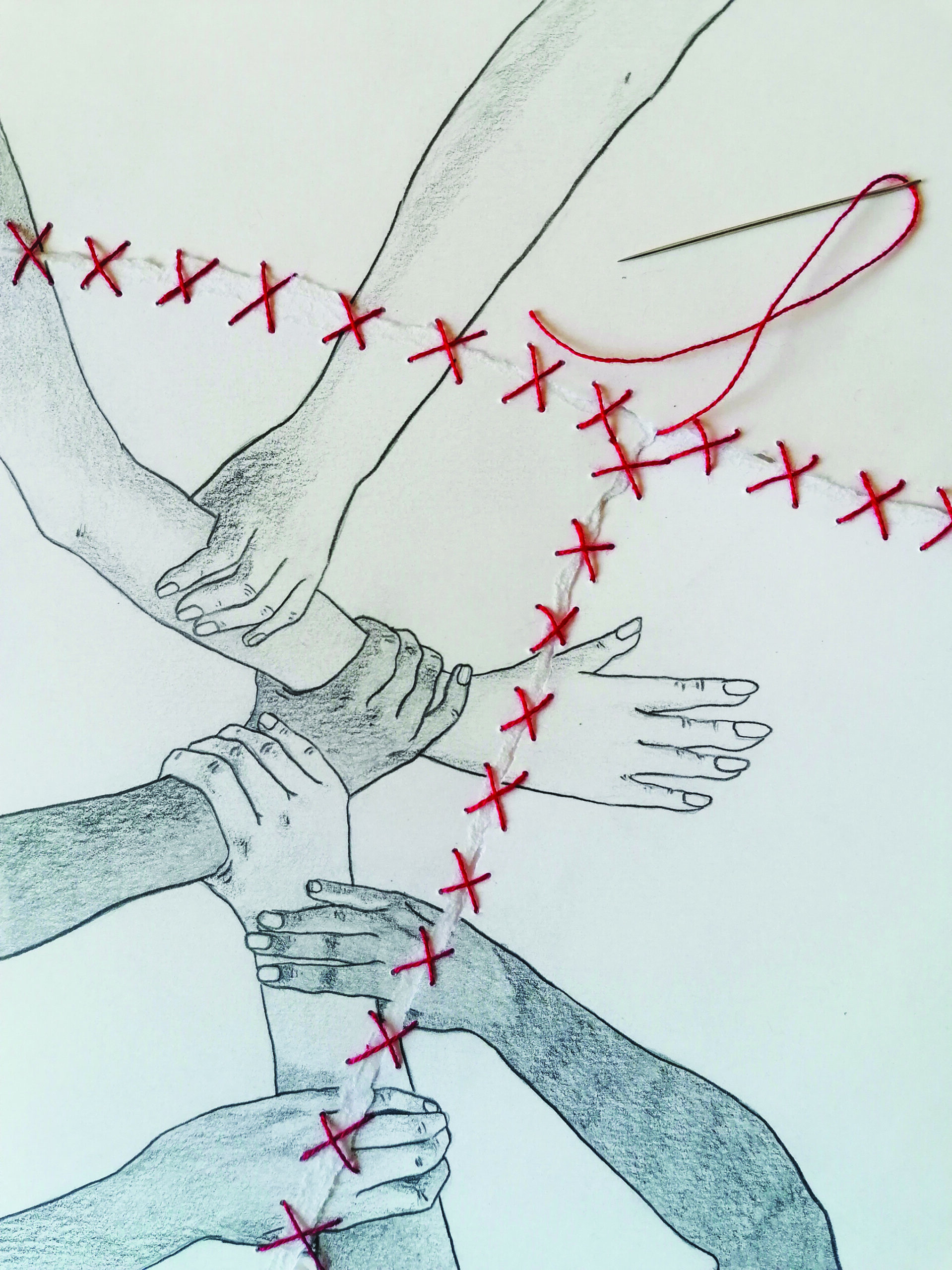


Zehra Doğan, acrylic on newspaper, 2017, Istanbul. Photograph: Jef Rabillon.
An interview with Enrica Rigo
By Constanza Cisneros and Marta Malo (La Laboratoria)
Translation into English by Jennie Gant.
Enrica Rigo is a lecturer in Philosophy of Law at Roma Tre University, where she founded and coordinates the Legal Clinic on Migration and Citizenship and the Legal Clinic on the Fight against Gender-based Violence. She is also part of a transfeminist sailing cooperative that promotes anti-border activism and a member of the Global Sumud Flotilla’s legal team. Her latest book is La straniera. Migrazioni, asilo, sfruttamento in una prospettiva di genere (Carocci, 2022) — Migration, Asylum and Exploitation, translated into English by De Gruyter, 2022 and later published by Bristol University Press, (2026). Taking the forced deportation of nineteen women asylum seekers from the Ponte Galeria detention centre on the outskirts of Rome on 17 September 2015 as its starting point, the book analyses the connection between border authoritarianism and social reproduction, based on the assertion that the right to migrate is non-negotiable. The vitality of her argument can only come from someone who, like all the intellectuals we admire, combines research and teaching with a vigorous commitment to the fight against borders. She repeatedly drives initiatives in alliance with migrants in this struggle. Her voice is indispensable to this series of interviews that we are publishing at La Laboratoria, which focus on war, patriarchal-colonial restoration, and the internationalism we so urgently need.
Constanza Cisneros and Marta Malo. Tell us about the initiatives you are involved in. What led you to set up the legal clinics and the sailing co-operative?
Enrica Rigo. I believe the common thread running through these experiences is that, in all three cases, they are ‘invented institutions’ — to borrow a term from the Basaglia tradition of democratic psychiatry — that is, institutions that seek to open up spaces for social transformation and invent practices of justice. There is a lot of talk today about abolitionism and, as both a researcher and an activist, I believe that the fight for freedom of movement and against borders must be paramount. But ‘abolition democracy’, to quote Du Bois, is never merely the negation of something; it also always involves the construction of alternative, solidarity-based social institutions, and practices of the ‘commons’. With the legal clinics, we have looked at ways to experiment with forms of justice that shift the focus of intervention away from ‘resolving’ issues to taking responsibility for them within a paradigm of care. When law is understood as a process of decision-making, it becomes a force that takes things away: in making its decisions, it amputates. In other words, law reduces the multiple identities that each person embodies in order to fit them into legal categories, such as legal or illegal migrant, economic or forced migrant, victim, or perpetrator, and so on. Taking cases on involves learning to stick with the problem; to deal with the ‘mundane troubles’ — as Donna Haraway calls them — which are necessary for the reproduction of life and the relationships that sustain it.
CC/MM. We find this paradigm shift you’re proposing very interesting. Could you explain a little more clearly how it plays out in practice?
ER. It’s a line of thinking I’ve learned to develop, above all through my work with feminist centres against violence — places where the fight against gender-based violence is, primarily, a practice of self-determination. Using criminal law as a tool to combat violence, whether by imposing harsher penalties or creating new offences, makes no sense whatsoever. In fact, it contradicts our cry ‘We Want to Live’, which echoes through the squares of the ‘Ni una menos’ (Not One Less) movement. Violence against women rarely finds ‘solutions’ in criminal law, which ‘decides’ who is guilty and imprisons the perpetrators of violence (if they are convicted). Women continue to face the problem of the secondary victimization they suffer during trials, the consequences of the violence witnessed by their children, the economic violence that accompanies domestic violence, and the difficulty of finding paths to autonomy in a patriarchal society. The same is true for migrants, and even more so for trans migrant women. The Legal Clinic has become a key point of reference in the area for this group, thanks above all to the invaluable work of Martina Millefiorini.
There is no law that is ‘on the side’ of those who cross borders. This is why, when even a partial outcome is achieved — such as release from a detention centre or the granting of a residence permit — we must continue to push the boundaries of the law, explore new avenues and persist with actions across different spheres to address the complexity of the situation. No institution treats trans migrants as if they were covered by the system. From access to justice and work to the asylum system, reception facilities, healthcare and housing, every institution treats trans migrants as if they were incongruous individuals who transgress its rules. This is, in a way, the paradox we face. The law must not only be applied, but also be transgressed, forced in some way — even if that is through law itself and the systems provided by law — in order to sustain existences that it finds incongruous.
CC/MM. What role does transfeminism play in your legal practice, both within and beyond the law?
ER. El The Italian transfeminist movement ‘Non Una di Meno’ has been fundamental to the Legal Clinic and to me personally. The year 2016, when the transfeminist wave swept over us, coincided with the year that saw the highest number of migrant women crossing the Mediterranean. The alliance has been essential, but not something that came about automatically. For us, it meant having to reflect on what it means to oppose the structural violence of patriarchy that transcends borders, using the law in legal proceedings, before administrative bodies, and so on. We made policy decisions, such as representing all women and deciding on strategies with them, regardless of whether they chose to leave situations of exploitation. This approach has set us apart significantly from, for example, anti-trafficking organisations, including those that follow feminist practices, and that we collaborate with on a constant basis. The legal clinic has represented women who, for example, came to their first appointments accompanied by their exploiters, who waited for them outside. This is (understandably) unthinkable if you work as an anti-trafficking centre. Yet it is often precisely these women who are excluded from any access to justice.
In Italy, the legal culture is white and dominated by men. Access to rights for women, migrants, non-cisgender people, and the impoverished is profoundly characterized by a strong sense of paternalism, by victimizing rhetoric and by a tendency to ‘exoticize’ violence as a cultural issue. All of this is very much reflected in the courts, but also in law schools. Legal clinics are not immune to these contradictions — practices never are. Sometimes, using humanitarian rhetoric can be a viable legal strategy. However, we endeavour to do so from a position that takes an unconditional stand against border violence and in favour of freedom of movement.
There is a movement that sees itself as ‘feminism’ and which features heavily in the dominant public discourse (which, it is worth remembering, is dominated by men). This movement takes a prohibitionist stance towards sex work and non-traditional forms of parenting. It claims a monopoly on defining what constitutes patriarchal oppression yet excludes trans women from this definition. It invokes punishment and imprisonment as a solution to gender-based violence, and it justifies racist migration policies under the guise of lawfulness. Without going as far as to call this femonationalism, I would describe it as a very prevalent, insidious, and conservative attitude. As far as I am concerned, feminism worthy of the name is revolutionary and, therefore, transfeminist.

CC/MM. Given your involvement in legal clinics, how do you interpret the new European context, between the tightening of border policies and the consolidation of the war regime?
ER. Viewed through the prism of law, the border — even when it operates through ‘differential’ or ‘selective’ inclusion — constitutes a typical mechanism for the amputation of identities. It acts as a meta-decision-making criterion that imposes separations within the continuum of life, between a ‘before’ and an ‘after’, between an ‘inside’ and an ‘outside’, and so on. A paradigm of transformative justice does not renounce conflict at all but rather shifts the emphasis from the moment of decision regarding the conflict — that is, its ‘resolution’ — to the transformation of the conditions and power relations that fuel the conflict itself.
The ways in which traditional legal doctrine conceives of war reproduce this very paradigm of decision-making regarding conflict, whether to establish a ‘before’ and ‘after’ with respect to the ‘outbreak’ of hostilities or to draw a distinction between attack and defence. The definition of ‘aggression’ is thus reduced to identifying the moment when the first shot is fired, which understood as the shot that determines who is ‘at fault’, and diverts attention from the violence actually at play. This was the case with the devastating response to 7 October, which sought to erase everything that had happened before, but it is also the case when the MAGA doctrine attempts to justify an attack by Israel and the US on Iran by going so far as to invoke the 1979 storming of the US embassy in Tehran. Following this line of argument, this is also how ‘pre-emptive’ wars have been justified in recent decades. These follow the notion — already invoked by Schmitt — that ‘the best defence can be the best and most effective aggression’[1]. Whilst I recognize the analytical value of these categories, I am convinced that we must move beyond Schmitt, as well as the decision-making paradigm — even when applied critically — and replace it with a feminist perspective which has always emphasized that violence does not ‘erupt’; it is never attributable to an initial, unforeseen explosion. Violence is always a continuum, rooted in oppression and organized through apparatuses that encompass not only the arms industry, but also other repressive complexes such as prisons that protect authoritarian and coercive capitalism. These systems also include not only armies, but borders, and ‘moral economies’, ranging from patriarchy to the so-called national identities they are tasked with safeguarding. It is these apparatuses that sustain and enable regimes of war.
Gaza vividly illustrates this continuum of violence. In other words, it shows us that genocide is not an extermination confined to a specific space and time, ending with the cessation of hostilities. It is, rather, a systematic attack on the structures necessary for the reproduction of life and its relationships, the consequences of which are passed on across generations and whose origins stretch far back in time. Many of the terms that have come into common use over the last two years, such as ‘scholasticide’, have been in use in Palestine for decades, but, above all, they carry the sense of this being commonplace, describing realities that are part of everyday life that have persisted throughout more than 70 years of occupation, and which relates to the uncertainty of passing through a checkpoint, accessing educational institutions, or returning home at night.
I believe that when we talk about regimes of war, we must also talk about these things which have taken on a sense of being commonplace realities, because it is by starting from here that we can find ways to combat them and build alternatives.
CC/MM. On 22 and 23 March, a referendum was held in Italy on a proposed reform of the judiciary put forward by Giorgia Meloni. What significance did this proposal hold within Meloni’s government programme? Are there differences between Meloni’s government and other authoritarian-style governments in Europe? How is the victory of the ‘NO’ vote viewed from the perspective of those at the base?
ER. The Meloni government’s first measure, just two weeks after it took office in late October 2022, was a decree-law against rave parties. The second, a few days later, was a directive from the Minister of the Interior to prevent the ship Humanity 1 from disembarking refugees rescued at sea. Since then, there has been a steady rise in criminalization, from the massacre of migrants in Cutro, Calabria [2], to Alfredo Cospito’s struggle against the special prison regime [3], and the most recent street protests [4]. The response to conflicts and social issues has been to introduce new offences and impose harsher penalties. Whilst it is true that rhetoric on security has been fuelled by both the left and the right, I believe we need to acknowledge a shift in direction. The Meloni government’s flagship legislation — the security decrees of April 2025 and February 2026 — redefines security as the security of property as well as of the state apparatus responsible for protecting it, namely the forces of law and order. What is being criminalized is the very right to question the law, ranging from the offence of rioting in prisons and migrant detention centres to pre-trial detention for protests in public squares. The attempt at judicial reform, which, furthermore — as the right explicitly stated in its referendum campaign — was driven by a desire to align the judiciary with the prosecuting authorities, must be understood within this context. In other words, the criminalization of dissent also involves restricting legal avenues for challenging the law.
The result of the referendum has far exceeded expectations, thanks above all to the vote of younger people, and this strikes me as a sign that deserves our attention. I am convinced that this vote was not merely generational, but political and radical. There is a generation that has become politically conscious through its opposition to genocide, and there is a common thread running between the defence of property rights in the right-wing ‘security’ narrative and the racist supremacism of Trump, Netanyahu, Rubio, and Tony Blair. The Board of Peace’s corporate-colonial-prison complex is the most extreme expression of this common pattern.
As for the Meloni government’s position amongst the authoritarian right, I can only respond that one of the main areas of conflict with the judiciary has been migration, especially the plan to externalize borders and deport migrants to Albania. Unfortunately, this is not an area in which only the authoritarian right-wingers venture. Indeed, it reflects the direction in which Europe is heading with the European Pact on Migration, which is due to come into force in June.
But the war on migration is no longer merely about constructing ‘the other’ as an enemy. The riots in Minneapolis following the murder of US citizens should serve as a warning to remind us that the war on migration is, to all intents and purposes, a civil war. In other words, racist and property-owning supremacism is now openly waging war against us; against anyone who opposes regimes of war, racism, borders, and patriarchy.
Many have drawn on the image of civil war to describe Trump’s America and his war against migrants. I shall simply refer to an author I admire, Raya Dunayevskaya, who asserts that the class struggle and the struggle against slavery and supremacism must go hand in hand, reminding us that Marx wrote Das Kapital against the backdrop of the American Civil War.
CC/MM. In September 2025, the dockers in Genoa threatened to go on strike in solidarity with the ‘Global Sumud Flotilla’. Shortly afterwards, a general strike shook the whole country. How is an action of that magnitude organized, with such political and social impact? Where does this power of resistance come from, and what is emerging from below? What remains of that momentum?
ER. The demonstrations and general strikes of October 2025 were immensely powerful. I cannot answer the question of how an action of such magnitude is ‘organized’, because I believe the key lies precisely in the fact that these mobilizations transcend any single organisation. What seems indisputable to me is that the Flotilla has made the possibility of acting against an enormous, hegemonic, and terrible power real through a practice that is simple, direct, and understandable to anyone. It was this practice that unleashed an imagination of enormous power and at that moment we did in fact feel powerful.
Of course, I am aware that there have also been contradictions. There are those who, for example, have criticized the Flotilla and the dockers’ slogan ‘if they touch one of us, we’ll block everything’, arguing that the protests have, once again, been mobilized in the name of the ‘white saviour’. I do not agree with this interpretation. The dockers set a practice in motion — the blockade of ports and war logistics — just as the flotilla’s action broke through the blockade of Gaza. As I said, practices always contain contradictions … but it is through their action that their legitimacy, their power, and the possibility of an alternative justice are brought into play. This, in my view, not the rhetoric of the white saviour, was what brought people onto the streets in massive demonstrations that have offered a glimpse of this possibility of justice.
CC/MM. Not long ago, we translated a text you wrote together with Tatiana Montella in which you state:
“The law is not merely that which is guarded in the palaces of power and invoked by states to legitimize their borders and their wars. There is a law — expressed through the resistance of those that struggle, invoked by people moving across borders, practised by rescue ships — that does not beg for recognition, but practises and constitutes it, because it emerges where the law of states fails, betrays, and kills. It is this law that is taking shape today in the Mediterranean, transforming it from a sea of death into a sea of resistance.”
Can we say that the port and the sea are laboratories where resistance is put to the test?
ER. Indeed. Tatiana and I argue that the Mediterranean is a laboratory for an alternative vision of international law, beyond the realm of states — a law that derives its legitimacy from protecting life in the face of its destruction. Furthermore, the practices of migrants crossing the Mediterranean are practices which, by opposing the violence of borders, bring to the fore the possibility of a different order of justice.
I would like to clarify that ours is a situated perspective, as activists and as legal scholars who view the law as a terrain for contestation, rather than relying on the law as an instrument of emancipation in and of itself. The recognition of the state of necessity in the case of captains prosecuted for taking vessels across the Mediterranean has emerged from struggles in which the law itself has become a site of political contestation. The same is true of the recognition of gender-based violence as grounds for asylum, in which migrant women and their struggles have taken centre stage, not as victims but as political subjects. These are just two examples in which, through the legal clinic’s activism, we have put the law into practice as a terrain of struggle.
CC/MM. Following on from your reflections on the struggles in the Mediterranean as a space for the constitution of another form of law, we could say that internationalism, as a political practice, opens up a space for constitution in the face of a crumbling international order. Would you agree?
ER. Yes, I am absolutely convinced of that, and I would add that such internationalism can only be feminist and decolonial. I belong to that political generation for whom the Genoa movement was, for a long time, the point of reference. Looking back, I believe that movement was limited in that it failed to truly conceive of itself beyond Europe.
We set up the Legal Clinic 15 years ago as a way of introducing the issue of migration into universities and law schools, not just as a subject of study, but precisely so that migrant women and men could enter an environment they are normally excluded from. The wave of feminism that swept over us following the ‘long summer of migration’ in 2015 entered the Legal Clinic, literally, through the dozens of migrant women who were admitted to the Ponte Galeria detention centre. This was close to Rome-Fiumicino Airport, and the only repatriation centre with a women’s section. Thanks to word of mouth, they made their way to the Legal Clinic’s reception desk. Migration forces us to rethink the spaces of political action, and this constantly puts us to the test.
Now, in my view, the movement that has placed ‘global Palestine’ at the centre has shifted the focus of internationalism. The impetus comes mainly from the ‘Global South’ and, at last, we have allowed ourselves to be carried along by it. This is true both of South Africa’s case against Israel before the International Court of Justice and of the Global Sumud Flotilla. Both reverse the point of view from which the international order is usually viewed, starting from a West in decline. I believe this is the course we must maintain.
The Legal Clinic is a collective project. The reflections presented here, for which I take full responsibility, are the result of ongoing debate not only with Martina Millefioniri and Tatiana Montella, mentioned in the interview, but also with Carlo Caprioglio, Jacopo Di Giovanni, Silvia Tripiciano and the many, many students who are an inexhaustible source of energy and enthusiasm for the project.
Notes
[1] Carl Schmitt, The Nomos of the Earth in the International Law of the Jus publicum Europaeum (1950), Telos Press, New York, 2006.
[2] At dawn on 26 February 2023, a boat carrying some 175 people capsized a few metres off the coast of Cutro, Calabria, resulting in the deaths of 95 people and an unknown number of missing persons. Matteo Piantedosi, Meloni’s Minister of the Interior, attempted to blame the deaths on the ship’s captains and the migrants themselves, but thanks to popular mobilization and the investigative work of the Crotone Public Prosecutor’s Office, six Italian military personnel are currently facing charges of shipwreck through negligence and multiple counts of manslaughter (Editor’s note).
[3] Alfredo Cospito is an Italian activist with the Informal Anarchist Federation who was convicted in March 2022 of an attack. He has been in prison for over 10 years and, from October 2022 to April 2023, undertook a six-month hunger strike to protest the application of Article 41-bis of the prison regulations, which allows solitary confinement. His case is the first in which this article has been applied to an anarchist activist for an attack in which no one was injured (Editor’s note).
[4] In June 2025, the Italian ‘Security Decree-Law’ received final approval; amongst other things, it introduces several new offences relating to protest: the offence of ‘rioting’ in prisons or detention centres, carrying a sentence of up to five years’ imprisonment, the offence of blocking or obstructing roads and railways, punishable by up to two years’ imprisonment if carried out in a group; and the offence of squatting, punishable by up to seven years’ imprisonment. The new law also introduces some new protective measures for law enforcement agencies and strengthens criminal protection for police officers, with harsher penalties for causing injury, resisting arrest, and using violence against a public official (Editor’s note).


Transcription, editing, and translation carried out with the support of FfAI and RLS -Madrid